
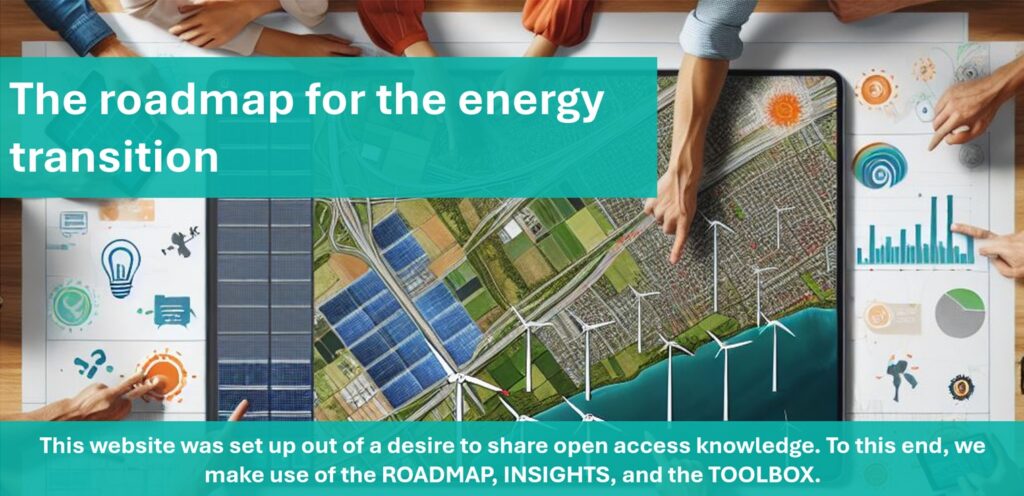
The “Energy Transition Route Planner” (ETR), together with the We-Energy Insight and We-Energy Toolbox, is a support process for local and sustainable energy planning. The ETR was developed to support energy communities (stakeholders within a region who want to become more sustainable together, e.g., residents, municipality, businesses, etc.) in the energy transition through a tailor-made, case-based approach (ROUTEPLANNER), a collection of usable knowledge (INSIGHT), and tools (TOOLBOX) for and by the energy community. Click on the maps below for more information.
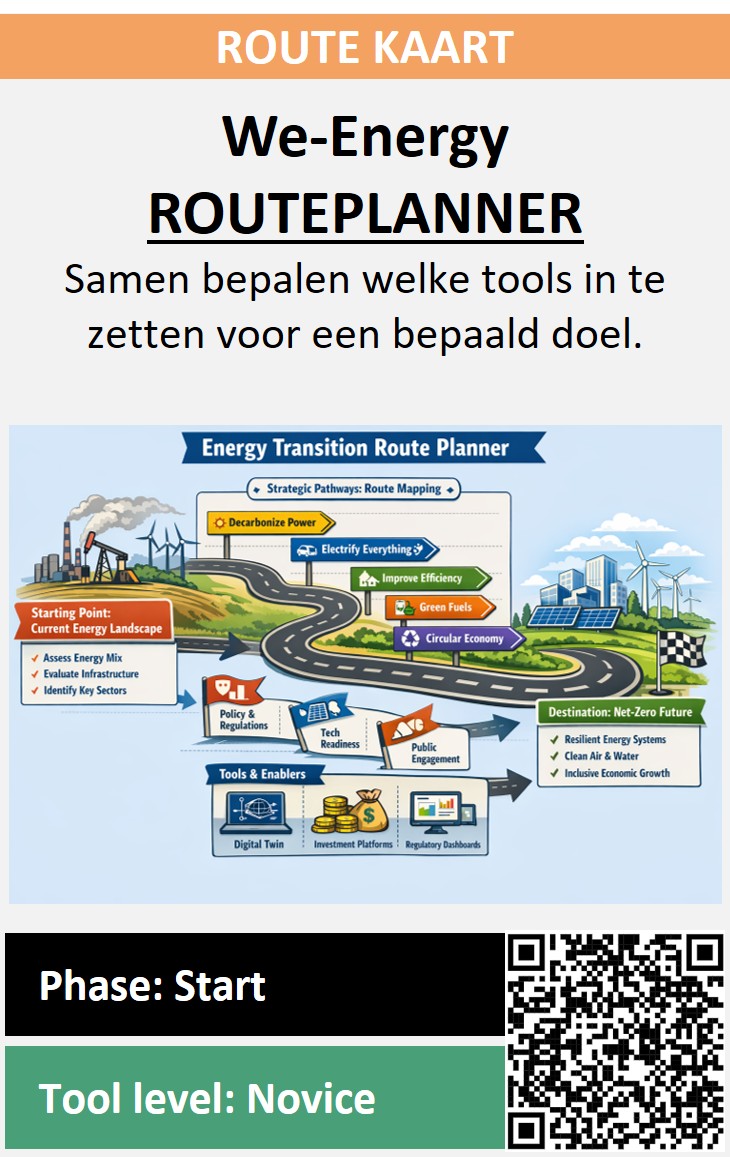
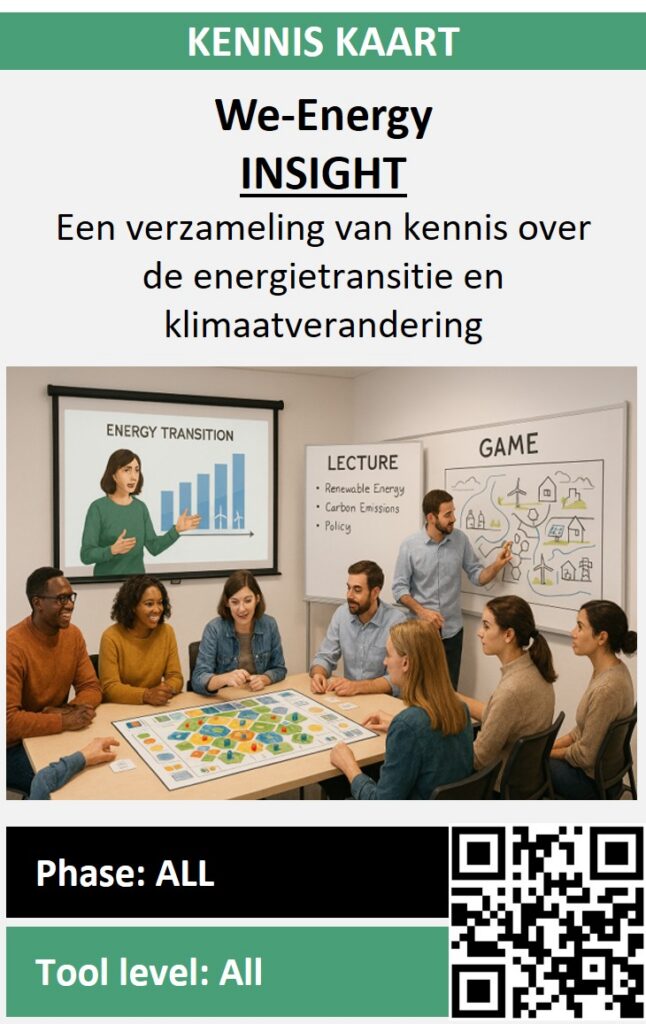
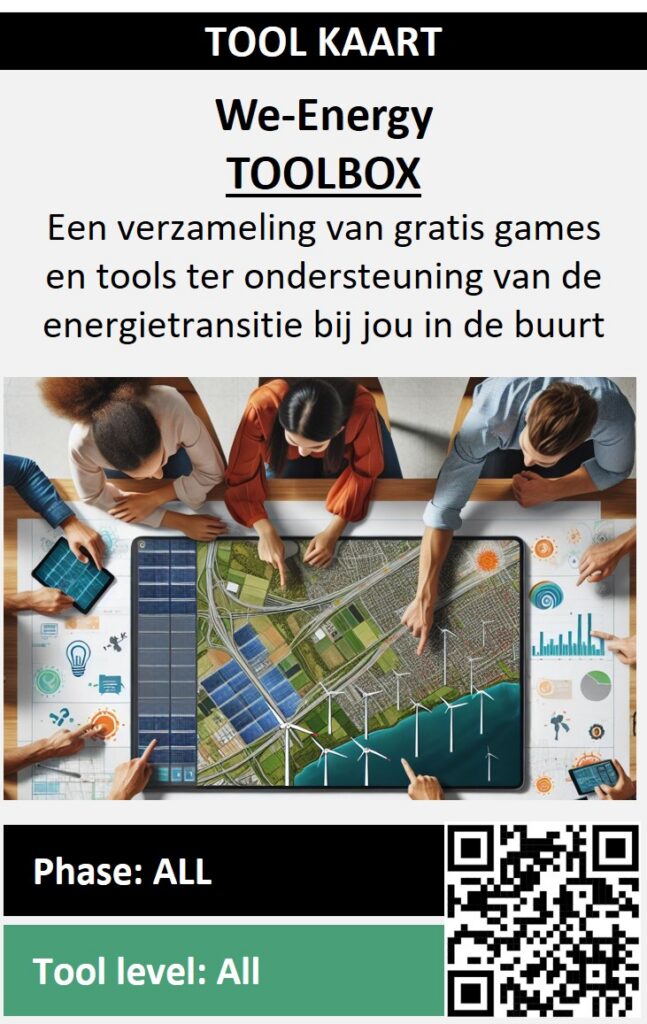
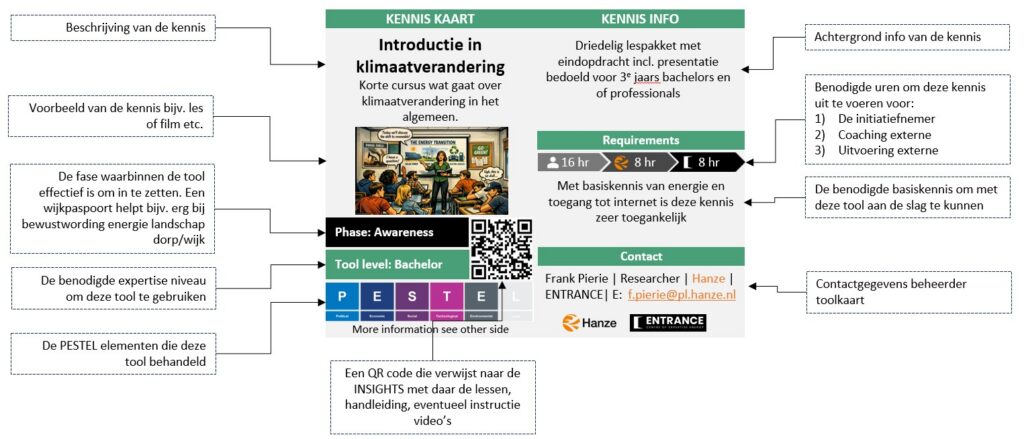
How does a ROUTE, KNOWLEDGE, or TOOL card work? Read on:
The overview below lists the three main themes of We-Energy Games, described on a Tool card. It briefly describes what the tool does, when you can use it, and what level of knowledge or tool the user needs to have to use it. Below is a further explanation of a Knowledge card example.
Why the We-Energy ROUTE PLANNER? Read more:
Climate change is the greatest challenge facing current and future generations, for which no simple solution is available. If we want to move towards a sustainable and renewable society, much must change at a global level. This entails cooperation as well as achieving nationally set targets.
In relation to the energy transition in the Netherlands, many changes are expected at the local level, which means that companies, residents, the municipality, and the grid operator must jointly find solutions for specific areas and the many challenges associated with the energy transition and beyond. To ensure the smooth running of the aforementioned process and the necessary cooperation within it, an environment is needed where stakeholders can arrive at a widely supported solution together. Within We-Energy Games, this environment is also referred to as the ROUTAPLANNER. Effective communication is crucial for gaining support for the energy transition and for making informed and joint decisions. To discuss and develop future renewable solutions, such as an Energy Community, it is necessary for all stakeholders to be at the same level of knowledge; in other words, they must speak the same language. To achieve this, a common language must be developed that helps stakeholders understand each other better. To address this, an approach based on serious gaming has been developed at Hanze University of Applied Sciences Groningen: the so-called Energy Transition Roadmap (ETR). Within this approach, the focus is on supporting processes of awareness, readiness, planning, and monitoring among stakeholders, both individually and in groups. Throughout this process, it is essential to understand the needs of stakeholders at every stage and to support them appropriately with targeted interventions, the so-called tools. Timing is of great importance in this regard, as an intervention must align with the specific needs of the stakeholders at that moment. For example, a proven effective tool may lose its effectiveness if deployed at the wrong time for the wrong purpose. The ETR approach therefore considers both the process and the available tools. Depending on the needs of the stakeholders, specific tools can be deployed as an intervention. This helps stakeholders develop a common language and receive the right information in the right way (clearly, understandably, and transparently), enabling them to make informed decisions.
Previous research and projects, read more:
The Toolbox approach, internally referred to as the Energy Transition Roadmap, was developed within the ESTRAC project, where the first tools were applied in the Buren case study on Ameland to provide residents with insight into energy measures for buildings. The concept was further developed within the Making City project, where the toolbox was expanded and applied in five districts of the city of Groningen to determine the impact of future scenarios on the electricity grid. In addition, new tools and interventions were developed within the Coöperatief in Balans, Flexpost, and Groningen Stroomt Door projects. Finally, the first complete concept of the Toolbox approach, with a strong focus on the process, was developed within the Regiodeal project. There, the concept was applied in five municipalities in the province of Friesland, combining tools from social, technical, economic, and legal perspectives within a single overarching process to support local initiatives (such as energy cooperatives and municipalities). Currently, the toolbox and the associated process are being further developed within the Sustainable Cities project, in which the Hanze toolbox is being expanded with tools from the Utrecht University of Applied Sciences. Joint research is being conducted into the availability of tools and their application in shared cases between Hanze and the Utrecht University of Applied Sciences. This includes the Fingerprint approach applied in both the Paddepoel experimental area and Southeast Friesland. At present, the ETR is being further developed within the POL4PED project.
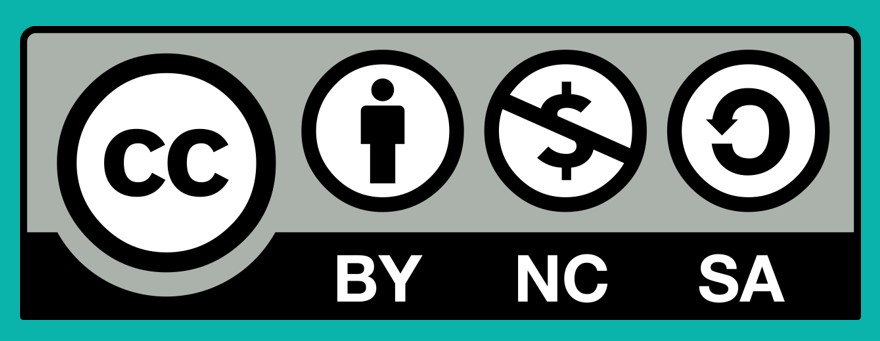
This website shares knowledge under the “Creative Commons Licenses” concept, with the specific sub-license “Atribution – Non-commercial – Share Alike”. This means that all available tools may be used without making a profit on the tool itself. Additionally, the tool may be further developed or modified, but with attribution to the original creators of the tool.
*Disclaimer: Use of the tools is at your own risk. Unfortunately, the validity of the tools cannot be guaranteed; consequently, incorrect use and/or assumptions may generate results that are not 100% realistic. Additionally, all tools are intended for awareness, support, and planning. Further in-depth analysis is always required for implementation.
This website is powered by:


